If your AC unit just died in the middle of a heatwave, the bright blue vest at the Lowe’s service desk looks like a lifeline. You trust the brand. You have the credit card. It feels safe.
But when you sign a contract for heating, ventilating, and air conditioning (HVAC) installation through Lowe’s, you aren’t hiring Lowe’s. You are hiring a sales funnel. Lowe’s acts as a lead generator for third-party subcontractors (“PRO Providers”), adding a corporate markup to the top of the bid.
We analyzed quotes, contract terms, and the new federal refrigerant mandates to determine if the convenience of a big-box install is worth the premium.
Before jumping into the details, remember to take the Lowe’s customer satisfaction survey at www.lowes.com/survey to win a $500 check by validating your receipt and entry eligibility.
The Model: You Are Buying a “Project,” Not a Product
Many homeowners misunderstand how Lowe’s operates in the HVAC space. You cannot walk into the aisle, load a Trane condenser onto a cart, and pay for installation at the register.
Lowe’s sells HVAC installation as a “Furnish and Install” package. This means:
- No DIY Hand-offs: You cannot purchase a lower-priced direct-to-consumer unit (such as a Mr. Cool or Goodman unit) and ask Lowe’s to install it. They will strictly refuse “labor-only” contracts to protect their equipment margin.
- Brand Limitations: Lowe’s generally partners with specific manufacturers for these programs, most commonly Trane and Lennox. If you want a Carrier or Rheem system, you are likely out of luck unless the specific local subcontractor happens to carry them (which is rare in Lowe’s).
- The Subcontractor Roulette: The person entering your home is not employed by Lowe’s. They are an independent contractor who pays Lowe’s a fee (or takes a lower cut) for the lead.
Warning: In May 2025, a BBB complaint highlighted a case where a Lowe’s subcontractor used exterior-grade sealant (OSI QUAD) indoors, releasing toxic fumes. Because of the finger-pointing between Lowe’s and the sub, the homeowner faced months of delays. This is the “accountability gap” inherent in the middleman model.
The 2025 Refrigerant Cliff: R-454B is Here
If you are quoting a system right now, you need to check the specs immediately. As of January 1, 2025, the EPA has restricted the manufacturing of R-410A equipment. The industry is transitioning to R-454B (Opteon XL41), a “mildly flammable” (A2L) refrigerant with lower global warming potential.
Why does this matter for your wallet?
- Equipment Cost Surge: R-454B systems require new sensors and dissipation systems to handle the flammability risk. This has added approximately $1,500 to $2,500 to the base cost of a standard installation compared to older prices.
- Refill Scarcity: If a contractor tries to sell you a “leftover” R-410A unit to save money, realize that R-410A prices are skyrocketing as production halts. A future leak could cost a fortune to refill.
- Training Gap: Lowe’s subcontractors vary in quality. Ensure the technician installing your system is specifically trained on A2L refrigerants. Improper brazing on an R-454B line set is a significant safety hazard.
Financing: The “MyLowe’s Rewards” Equation
Lowe’s leans heavily on financing to close these massive sales. With the transition from the “Advantage Card” to the MyLowe’s Rewards Credit Card, the terms have shifted.
The 5% Trap
You typically get a choice: 5% off the purchase price or special financing. You cannot stack them.
On a $15,000 system, 5% off saves you $750. However, if that system is priced $3,000 higher than a local competitor’s quote, the 5% discount is mathematically irrelevant. You are still overpaying by $2,250.
The 84-Month Option
Lowe’s currently offers 84 Fixed Monthly Payments at 9.99% APR.
If you finance $15,000 at 9.99% for 7 years, you will pay approximately $5,800 in interest alone. The total project cost balloons to over $20,000.
120-Month Project Financing
For purchases over $2,500, there is often a 120-month offer at 9.99%. While this lowers the monthly payment, it extends the debt obligation for a full decade, likely longer than the compressor’s warranty.
Lowe’s Pro vs. Homeowner: Is there a secret tier?
Keywords like “Lowe’s Pro” suggest a better deal for contractors. If you have a Lowe’s MVP Pro Rewards account, you might be tempted to run the purchase through the Volume Savings Program (VSP).
The Reality: VSP is designed for contractors buying materials (lumber, bulk appliances). It is rarely applicable to “Furnish and Install” HVAC contracts because the labor component is fixed by the third-party provider. A Pro account might get you points, but it won’t drastically reduce the $18,000 quote for a new Trane unit.
The Verdict: When to Use Lowe’s (and When to Run)
Use Lowe’s If:
- Credit Constraints: You have high equity/credit with Synchrony Bank (Lowe’s issuer) and need to finance the system immediately without applying for new loans.
- Rural Availability: You live in a remote area where local HVAC specialists are scarce, but Lowe’s has a service contract that includes you.
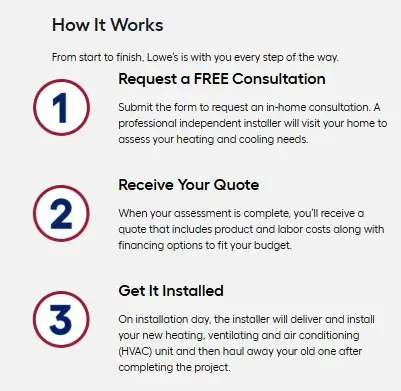
It works in three steps:
Avoid Lowe’s If:
- Price is Priority: You will almost certainly pay less by getting three quotes from local, family-owned HVAC companies.
- Complexity: If your home needs ductwork modification, zoning, or specific load calculations (Manual J), a direct relationship with a technician is safer than a relayed message through a store associate.
- Urgency: If your AC is out now, the Lowe’s process (assessment > quote > scheduling > install) typically moves more slowly than a hungry local contractor who can be there tomorrow morning.
Note regarding “Lowe’s Foods”: Please note that Lowe’s Home Improvement and Lowe’s Foods are separate corporate entities. Loyalty points, credit cards, and service contracts are not interchangeable between the grocery chain and the home improvement retailer.
- A Contractor’s Guide to Building Trust with Customer Feedback
- From Complaint to Case Study: How to Turn Negative Feedback into a Marketing Win
- How to Build Your First DIY Tool Kit from Lowe’s for Under $150
- The Ultimate Guide to Lowe’s Black Friday & Cyber Monday Tool Deals
- An Honest Review of FLEX Power Tools at Lowe’s: The New Contender
- Lowe’s Store Brands Explained: From Kobalt to Project Source and Blue Hawk
- We Analyzed 1,000 Lowe’s Customer Reviews on Power Tools: Here’s What We Learned
- A Lawyer Explains Your Retail Consumer Rights at Home Improvement Stores
- Lowe’s Special Order (SOS) Return Policy: The 20% Restocking Fee No One Mentions
- Lowe’s Price Match Policy Explained In-Depth
- The Lowe’s 1-Year Plant Guarantee: How to Return Dead Shrubs Without the Pot
- The Ultimate Annual Home Maintenance Checklist for Every Season in the USA
- How to Safely Start a DIY Project: Planning, Budgeting, and Avoiding Common Mistakes
- From Surveys to Savings: How to Maximize Rewards from Customer Feedback Programs
- The New Homeowner’s Essential Toolkit: 15 Must-Have Tools to Buy at Lowe’s