Most homeowners assume that when they hire Lowe’s, a uniformed employee will drive a branded truck to their house. This is incorrect. Lowe’s operates on an “Installed Sales” model. They act as the sales agent and bank, while the actual labor is farmed out to local third-party subcontractors (PRO providers).
How the money flows:
- You pay Lowe’s the full contract amount (Material, Labor, and Management Fee).
- Lowe’s keeps a percentage (the “spill”) to cover marketing, warranty liability, and profit.
- Lowe’s issues a purchase order to a local fencing company to do the work at a negotiated lower rate.
This structure creates what we call the “Subcontractor Lottery.” In some regions, Lowe’s partners with the best fencing crew in town. In others, they may use whichever contractor accepts the lowest bid. Your experience depends entirely on this local partnership, not on Lowe’s corporate policy.
I entered the Lowe’s Survey by navigating to the official portal at www.lowes.com/survey right after placing an order for my DIY fence.
Cost Analysis: Price Per Linear Foot
The following table breaks down the estimated costs for standard residential installations (flat terrain, no removal of the old fence). These figures combine material and labor.
| Pressure Treated Wood (Pine) | $23 – $35 | $4,600 – $7,000 | Moderate (15 yrs) |
| Cedar Wood | $35 – $55 | $7,000 – $11,000 | High (20+ yrs) |
| Vinyl (PVC) | $30 – $60 | $6,000 – $12,000 | Very High (Lifetime) |
| Composite (Trex) | $75 – $85+ | $15,000 – $17,000+ | Maximum (25+ yrs) |
| Chain Link | $15 – $30 | $3,000 – $6,000 | High (Industrial) |
Note: These estimates rarely include gates (add $150–$400 per gate), permits ($50–$200), or haul-away fees for old fencing.
Material Markups: The “Retail vs. Project” Gap
One of the most persistent questions is whether Lowe’s charges a premium on the materials when they install them. The answer is nuanced.
Typically, the “Project Quote” you receive is a lump sum. It does not itemize the cost of every screw and picket. If you were to buy the materials yourself off the shelf, you would pay the retail price. However, when you bundle it with installation:
- No Bulk Discount: Unlike a local fencing contractor who buys wholesale from a lumber yard, Lowe’s effectively “sells” the materials to your project at near-retail pricing.
- Delivery Fees: Standalone delivery for fence panels can cost $79+. In an installation package, this is often “bundled” but still present in the final number.
- Waste Factor: A local pro might optimize cuts to save money. Big-box quotes often include a standard 10% waste overage that you pay for, whether it is used.
The Verdict: You are generally paying full retail for materials plus a labor rate that includes the subcontractor’s fee AND Lowe’s margin.
The Hidden “Hard Dig” Fee
Review your contract for the “Hard Dig” clause. This is where many homeowners get blindsided. Standard installation quotes assume “normal soil conditions.”
If the auger hits rock, concrete, or heavy roots, the installer stops. The contract usually stipulates an additional fee per hole for switching to a jackhammer or a manual digging bar. This fee can range from $25 to $50 per hole. In rocky regions (like the Northeast or Texas Hill Country), this can add $1,000+ to a bill instantly.
Other Hidden Costs
- Permit Runner Fees: While Lowe’s can handle permits, they often charge a processing fee in addition to the actual town permit cost.
- Line Clearing: If you have bushes or ivy along the fence line, the installer is not a landscaper. If they have to clear it, you will be billed heavily, or they will simply refuse to install until you clear it.
- Spoils Removal: The dirt that comes out of the hole has to go somewhere. “Spoils removal” is rarely included. Usually, they leave the dirt in a pile next to the post unless you pay extra.
Warranty Wars: Labor vs. Material
Understanding the warranty is critical to judging value. Lowe’s splits the warranty into two parts:
1. The Lowe’s Labor Warranty (1 Year)
Lowe’s guarantees the workmanship for one year. If a gate starts sagging, a post wobbles, or a panel blows off due to poor fastening within 12 months, Lowe’s will fix it. This is a strong benefit because Lowe’s is not going out of business. A “Chuck in a Truck” handyman might change his phone number; Lowe’s will answer.
2. The Manufacturer Material Warranty (15+ Years)
The wood, vinyl, or metal is covered by the manufacturer (e.g., Barrette Outdoor Living), not Lowe’s. You must read the fine print.
- Ground Contact Exclusion: Many pre-assembled wood panels are NOT rated for ground contact. If the installer buries the bottom rail in dirt to close a gap, and it rots, the manufacturer’s warranty is void.
- Wind Damage: Most warranties exclude “Acts of God” (winds over roughly 40mph).
- Gate Hardware: Often carries a shorter warranty than the fence pickets.
Lowe’s vs. Local Contractor
When should you use Lowe’s, and when should you go local?
Choose Lowe’s If:
- You Need Financing: The Lowe’s Advantage Card often offers 84 months of fixed payments or varying periods of 0% interest (Deferred Interest). Local contractors rarely match this.
- You Want Accountability: If the job goes south, you can complain to a corporate entity that cares about its stock price and public reputation.
- You Want Standard Materials: If you are happy with the standard white vinyl or pressure-treated pine available in-store, the supply chain is reliable.
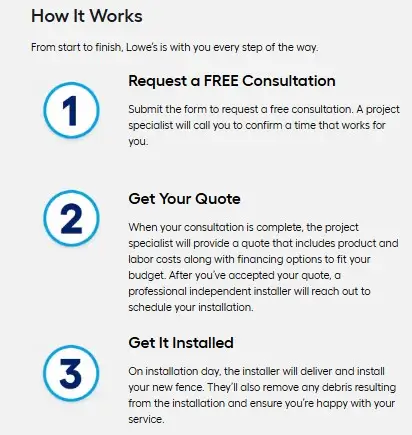
It works in 3 steps:
Choose a Local Pro If:
- You Have Complex Terrain: Steep grades that require custom “racking” or “stepping” of panels are often better handled by specialists than by generalist subcontractors.
- You Want Custom Wood: If you want Western Red Cedar or a specific board-on-board style not sold in Lowe’s panels.
- Speed is Critical: Lowe’s administrative process (Measure > Quote > Corporate Approval > Material Order > Install) is often slower than a local guy who can start next Monday.
Final Verdict
Lowe’s fence installation is a financial product as much as it is a construction service. You are paying a premium (roughly 15-20% over a direct hire) for the ability to finance the project and the security of a corporate labor warranty.
If you have the cash on hand and know a reputable local fence builder, you will likely get better material value and a lower price by going direct. However, for homeowners who need to spread the cost over 24 months without interest, the Lowe’s program is a viable, safe solution, provided you budget for the “Hard Dig” fees.
- Can I Stack Lowe’s Foods Coupons? Master the Coupon Policy.
- Lowe’s Military Discount vs. Credit Card 5% Off
- Lowe’s Advantage Card vs. Home Depot Consumer Card: A 5-Year ROI Analysis
- Lowe’s MVP Pro Rewards: Calculated ROI for Small vs. Mid-Sized Contractors
- The Truth About Lowe’s Commercial Credit: Net 30 Terms and Hidden Late Fees
- Lowe’s vs. Home Depot Pro Xtra: Who Actually Offers Better Bulk Volume Savings?
- Navigating the Lowe’s Pre-Load Discover Card: Limits and Cash Flow Benefits
- The True Cost of Lowe’s Flooring Installation
- Lowe’s Window Replacement Services: Analyzing Warranty Loopholes and Subcontractor Vetting
- Kitchen Cabinet Refacing at Lowe’s: Is the Markup Worth the Project Management?
- HVAC Installation through Lowe’s: The Middleman Tax Exposed
- Lowe’s Fence Installation Review: Material Markups vs. Labor Efficiency
- Lowe’s Major Appliance Protection Plan: A Clause-by-Clause Worthiness Audit
- Lowe’s Tool Rental vs. Home Depot Rental: Deposit Rules, 4-Hour Rates, and Brand Availability
- Lowe’s Price Tags: Master Yellow vs. Green vs. Red Tags